Gemini Decisions API: Score Options Instead of Generating Replies
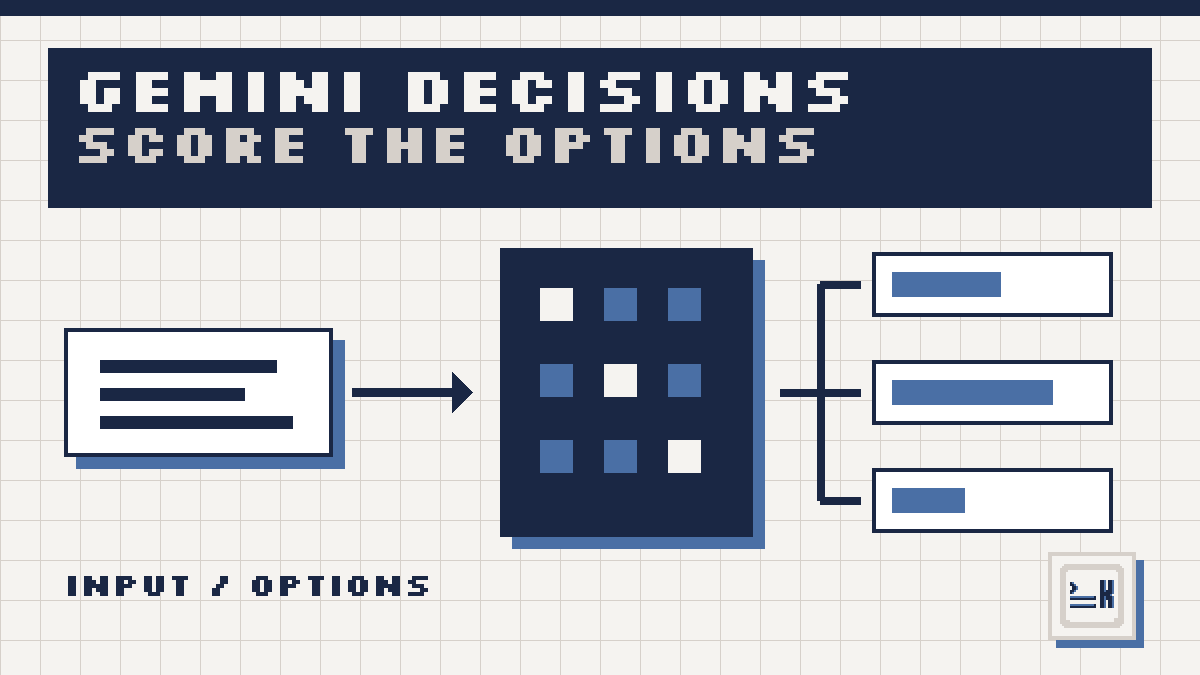
Google announced the Gemini Decisions API on 11 November 2026. Powered by Gemini Decision 1, the endpoint is designed for bounded questions such as choosing a route or grading an input against a rubric. Instead of writing a conversational answer that an application must parse, it returns typed answers, probabilities and confidence information.
One shared input, several independent questions
Google says a request can combine text, images, audio, video and PDFs in a shared input, with a context limit of 256K tokens and up to 1,000 independent questions. Each question is evaluated against that input; the documentation says questions cannot see one another’s answers. This is not a chain of a thousand cooperating reasoning steps.
The interface has three question types: a yes/no check, a choice from a fixed list, and a score against an ordered rubric. Code can use the structured result directly rather than trying to extract a decision from a paragraph of generated prose.
That distinction is useful for routing work to the appropriate handler or flagging an uncertain case for review. It does not mean that the API itself grants permission to run a tool or that the selected option is necessarily correct.
Confidence is a signal, not an authorization boundary
The developer documentation recommends narrow questions and combining their answers in ordinary application code. It also exposes confidence information so a system can send ambiguous cases to a fallback or reviewer.
A confidence score is still a model output. Before using it to automate a workflow, test it on representative inputs and decide what to do when a result is wrong or uncertain. Access controls and approval rules should remain outside the model; a scored option must not silently expand what an application is allowed to do.
What Google’s pricing announcement says
At launch, Google listed US$0.10 per one million input tokens and no output-token charge. The company says shared input is billed once per request, while each question adds its instruction and criteria tokens. The announced no-cost tier is for prototyping, not a promise that every account or workload will be free.
Google also reports latency and benchmark advantages, but this article does not reproduce those measurements or promise that they apply to every input size, modality or deployment. Check current pricing, service limits and regional availability before committing an application’s budget.
Availability and the practical next step
The launch announcement points developers to the Gemini API and Google AI Studio. It describes ecosystem integrations as rolling out and Google Cloud support as coming soon. Those are different availability states; they should not be collapsed into a claim that the endpoint is already available through every listed platform.
The useful question for a developer is whether a task really has a small, explicit set of outcomes. If it does, compare this typed decision interface with the current workflow using your own error cases, cost accounting and review rules. If the task needs open-ended explanation or new information, a fixed-choice score is not a replacement for that work.
Primary sources
Compiled with AI assistance from the linked primary sources. Publisher claims are attributed; no independent performance testing or personal verification by Kağan Erkan is claimed.