Gemini 4 Hydrogen: A Killer Subagent, Not a ChatGPT Killer

Gemini 4 Hydrogen does not make me want to replace ChatGPT. It does make me want to give Gemini more work.
In my own work, its output is less polished than what I get from ChatGPT. But quality is not the whole buying decision. Regional subscription pricing, bundled storage and the Google tools you already use can make a less impressive model a meaningful competitor.
My verdict is simple: Hydrogen is a killer subagent, not a ChatGPT killer. That is my assessment, not a controlled benchmark result. The research below explains why the position makes sense without pretending my experience proves it for everyone.
What Google actually released
Google announced Hydrogen on November 12, 2026, positioning it as the workhorse of the Gemini 4 family. Its developer rollout includes Antigravity Orchestrator support for parallel agents, with worker and verifier roles. My interest in delegation therefore matches Google's stated positioning, although the announcement is not independent evidence that those agents work reliably. Source: Google's Hydrogen announcement.
I see its practical comparison group as models such as Claude Sonnet and GPT-6.1 Terra: models you might assign everyday work rather than automatically choosing the most expensive option. OpenAI describes Terra as a fast, efficient model for visual reasoning, computer use and writing. This is a workflow comparison, not a claim that all three deliver equivalent results. Source: OpenAI's Terra documentation.
The Artificial Analysis chart is encouraging—with a qualification
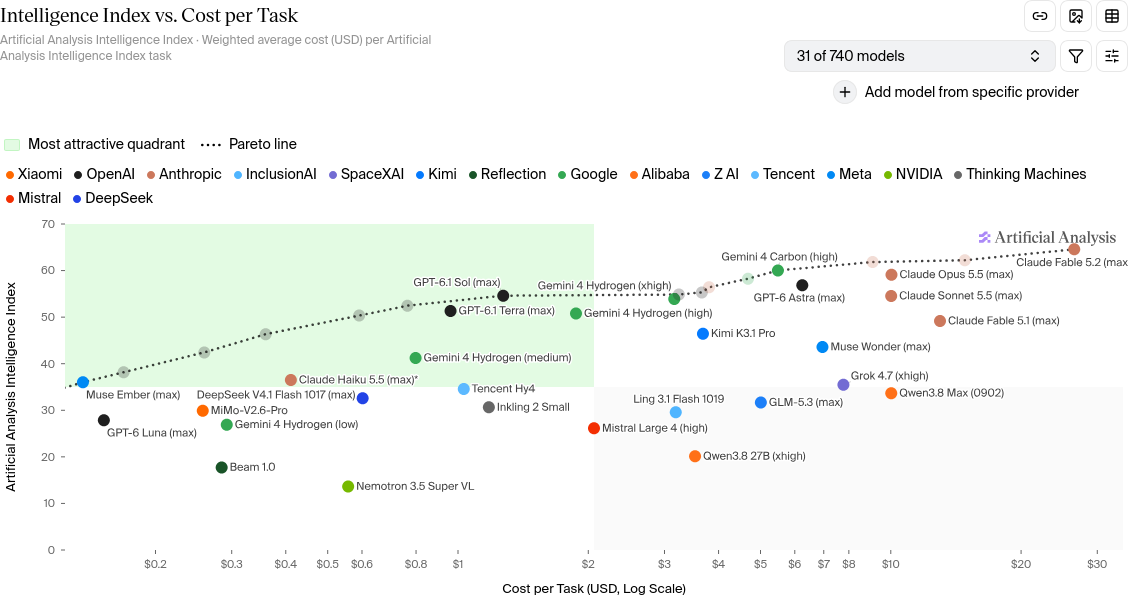
Source: Artificial Analysis homepage screenshot supplied for this article. Original chart and attribution preserved. Its capture date was not supplied; it is not labelled as a live November 14 ranking. Interactive source.
In that screenshot, Hydrogen is the only plotted Gemini model family inside Artificial Analysis's highlighted “most attractive quadrant,” with both medium and high effort inside it. That is a useful signal about the balance between its Intelligence Index score and estimated cost per task.
The qualification matters: the screenshot displays 31 of 740 models. It does not establish that Hydrogen is the only Gemini model that could qualify across the complete catalogue. Nor does every Hydrogen setting occupy that quadrant: low is below it, while xhigh is farther right.
I would read this as a reason to test those Hydrogen settings, not a reason to declare Gemini the winner. The chart measures an intelligence-and-cost relationship. It does not measure the polish of my finished work or the value of a consumer subscription.
Cheaper than Sonnet does not mean cheapest
The API comparison supports part of the value argument, but it needs to be specific. These are advertised standard input and output rates per one million text tokens, checked on November 14, 2026; they exclude caching, batch discounts and other special pricing.
| Model | Input | Output |
|---|---|---|
| Gemini 4 Hydrogen | $1.50 | $7.50 |
| Claude Sonnet 5.5 | $2.00 | $10.00 |
| GPT-6.1 Terra | $1.00 | $5.00 |
Sources: Google's API pricing, Anthropic's Sonnet page, and OpenAI's Terra documentation.
Hydrogen undercuts Sonnet on both listed rates. It does not undercut Terra: Terra's listed input and output rates are both lower. A fair comparison cannot turn “cheaper than Sonnet” into “cheaper than every alternative.”
Those rates also are not a completed-task bill. Generated tokens, tool calls, retries and the work needed to fix an answer all affect practical cost. A cheaper token can still produce a more expensive result. That is why I care about useful delegated work, not just inexpensive output.
The subscription changes the calculation
API pricing and consumer subscriptions are different purchases. Do not treat app usage limits as an API allowance; check any developer credits and API billing separately.
For a regional example, Google's Türkiye page listed regular monthly prices of ₺199.99 for AI Plus with 400 GB of storage and ₺869.99 for AI Pro with 5 TB, alongside introductory promotions. Both list Gemini inside Google applications, with different access levels. These are dated local listings, not a promise about another country's checkout or a like-for-like comparison with ChatGPT. Source: Google's Türkiye subscription page.
If you already need that storage and work in Gmail, Docs or the wider Google ecosystem, the bundle can matter more than an isolated model ranking. If you do not need those extras, do not count them as savings just because they appear on a plan page.
That is the basis of my regional-pricing recommendation: check your actual local price and the features you would otherwise pay for. I am not claiming Google is cheaper than every competing subscription in every market. App limits, model access and API access should be checked separately.
Where I would use it: underneath a stronger final reviewer
My complaint is not that Hydrogen has no useful capability. It is that I do not get the same finished quality I expect from ChatGPT.
That makes a subagent role attractive. Give it a bounded assignment, make the acceptance conditions explicit, and review the result before integrating it. That is how I would use the model; it is not a report of a new test suite or measured success rate.
The distinction is between contributing work and owning the final result. A worker can be valuable without being the model I trust to make every judgment or deliver the final polished artifact. Delegation still needs verification; adding agents is not a substitute for it.
For me, that is a more interesting recommendation than another sweeping replacement claim. Hydrogen can earn a place in the workflow without taking the lead.
Google's bigger advantage is the stack
The model is only part of the story. Google designs its TPU infrastructure, builds the model, and supplies developer tooling such as Antigravity. Its TPU documentation describes a custom-designed AI accelerator, while Hydrogen's launch puts the model into Google's own agent workflow. Sources: Google's TPU overview and Hydrogen launch.
Other labs' dependencies are concrete, not just hypothetical. Anthropic announced additional Google and Broadcom TPU capacity on April 6, 2026, with that capacity expected to start coming online in 2027. That is a future capacity commitment, not infrastructure I am claiming is already operational. Source: Anthropic's compute announcement.
My interpretation is that controlling more of the stack gives Google strategic room to compete on distribution, integration and economics. It does not prove Google has the lowest actual cost or wins every workload. It does mean I would not assess its position from one model leaderboard alone.
A provenance caveat: SynthID
Google's provenance technology also belongs in the buying decision. Google documents SynthID for generated text and other media; its text announcement describes deployment in the Gemini app and notes limitations, including weaker suitability for code and factual answers with little wording flexibility. Sources: Google's SynthID overview and text-watermarking explanation.
That is not enough to claim that every Hydrogen response, API result or code file receives the same detectable watermark. The sources reviewed do not establish that universal, Hydrogen-specific coverage. A watermark is also not a guarantee that every detector will identify every output.
For people who consider embedded provenance a deal breaker, my recommendation is to check the exact product and output type before adopting it. Do not assume either that everything is marked or that nothing is. I would not extend Google's documented SynthID behavior to unspecified identification systems without evidence.
Who I would recommend it to
Hydrogen is worth considering if your work already revolves around Google Workspace, your local subscription price makes the bundle attractive, or you want another model for supervised, bounded work.
I would not recommend switching from ChatGPT or Anthropic solely because Hydrogen exists. In my own work, the quality gap still matters. The useful proposition is narrower: a credible worker model, competitive pricing against Sonnet, and a bundle that can be valuable in the right market.
Less polish, meaningful value, and a strong subagent role. That is enough to make Hydrogen interesting without pretending it kills the competition.
Compiled with AI from Kagan Erkan's supplied observations and linked primary sources. Product facts checked November 14, 2026. No new hands-on tests, task timings or success-rate measurements are claimed.